This article was first published on October 30, 2020 at my Tumblr blog here.
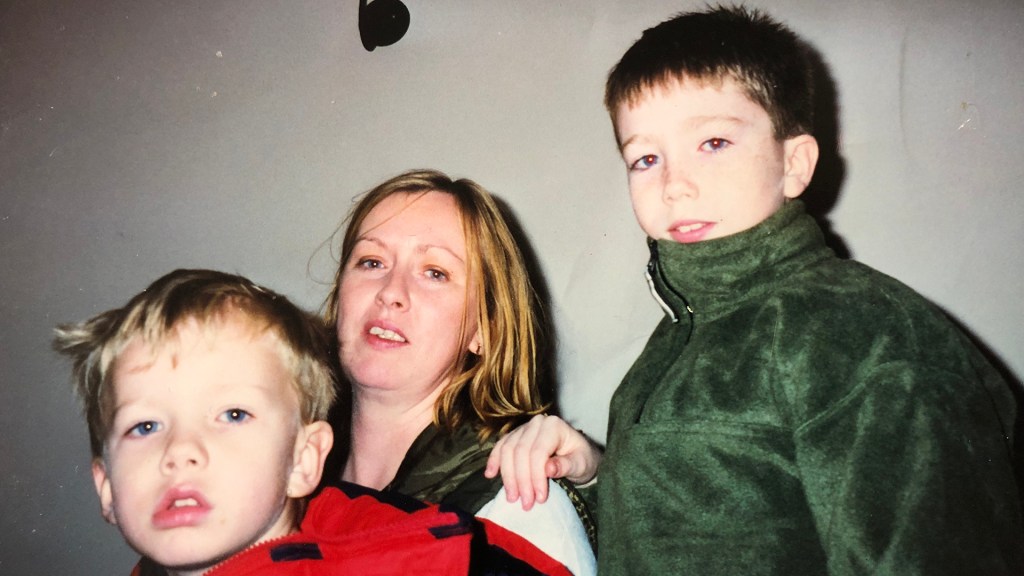
I was recently given a photograph. Of the three people in it, only I am still alive.
The photo was taken at my aunt Marie’s old place in Derry, at a time when my other aunt Helena was back home from America, possibly for her wedding. Late nineties probably. It was more than likely autumn or winter, because we’re all wearing fleeces and coats.
Looking at the photo, I think I was roughly 10 years of age, give or take, meaning Paddy would have been around three or four. Our mother, Charlene, would have been in her early thirties, which is around the same age as I am now (that is hard to get the head around).
Just a few years after the photo was taken our mother would be gone and everything would change utterly. She was just 37 when she died and the trajectories of our lives were totally mangled, then diverted towards oblivion.
Paddy, who was just seven at the time, survived only a decade or so after her death, barely making it to manhood before killing himself. After a childhood spent being shunted from pillar to post, while dealing with the destructive whims of an alcoholic father, he decided to end things. He was just 18. His life hadn’t even begun. He had so much love to give and so much to receive.
The writer Donald Antrim once expressed the view that suicide is “a natural history” and his observation resonates heavily with me, especially as I struggle to come to terms with Paddy’s death and, in particular, the incessant bullshit – like Chinese water torture -which preceded that final (inevitable?) catastrophe.
Writing in The New Yorker, Antrim expanded on his assertion, saying: “I do not understand suicide as a response to pain, or as a message to the living. I do not think of suicide as the act, the death, the fall from a height or the trigger pulled. I see it as a long illness, an illness with origins in trauma and isolation, in deprivation of touch, in violence and neglect, in the loss of home and belonging.”
Suicide is such a powerful and clearly defined term but experience of the phenomenon is not at all monolithic. It happens in different ways and the reasons people have for arriving at that most ultimate choice are unique to each and every individual. Likewise, the processing of grief arising from a suicide – indeed, any death – varies from person to person. Slogans just don’t cut it and they never will.
As soon as I saw the photo of the three of us together, a sense of isolation came over me as I remembered I was the only one who was still alive. Two sudden deaths, one a conscious choice, 11 years apart. Here is a photo of people I love in happier times, but all it does is remind me of their absence. It shouldn’t have been this way.
For anyone interested, the full Donald Antrim article, ‘Everywhere and Nowhere: A journey through suicide’ can be read here. It provides a fascinating perspective on the topic.
 Nothing is written