As the Nobel Peace Prize-winning politician John Hume observed, even the most intelligent students sometimes require a concept to be repeatedly articulated before they finally get it. Hume understood from his teaching days at St Columb’s College that he would have to lay out his analysis again and again until everyone had heard the message.
This brilliantly simple principle underpinned what became known as Hume’s ‘single transferable speech’, which the SDLP stalwart applied assiduously throughout the brutal 30-year quagmire of the Troubles in Ireland. Though he was occasionally derided for making the same points as the conflict raged, Hume’s steadfast messaging eventually got through and formed the basis of the 1998 Good Friday Agreement, which ushered in a new era of peace in the country.
In a world where bad-faith actors vow to ‘flood the zone with shit’ and those in high office openly revel in crass hypocrisy as they shred the fabric of society, it becomes a duty to constantly reiterate morally sound ideas and righteously reassert noble principles. We are, after all, prone to forgetting at the best of times (a phenomenon that appears to have worsened thanks to shrivelling attention spans), hence our need for structure and the sense of primal comfort that we draw from seasonal routines. Here, we are reminding ourselves of fundamentals, preserving knowledge and behaviours that have not only ensured our survival across millennia, but enriched the human experience in the process.
READ MORE: ‘We rise by lifting others’ – Discovering Ingersoll in Rome
Chance ushered an idea worth repeating into my consciousness over Christmas, when, after the usual deliberation and consternation that accompanies choosing something to watch nowadays, we decided to check out The Holdovers, an award-winning festive comedy-drama starring Paul Giamati. In it, Giamati’s surly character Paul Hunham is landed with the unenviable task of supervising students who must continue boarding on campus during the holidays because they have no other place to go.
One particular scene early in the film stayed with me. As Hunham half-heartedly receives instruction on what is expected of him, he utters a phrase from Cicero – initially laced with irony and disdain – which actually becomes a central moral pillar in the story.
“It’s not as though you had plans to leave campus anyway,” notes the headmaster as Hunham stands jaded before him. “And, of course, there’s a… nice little bonus in it for you.”
“Well,” sighs Hunham in response. “Non nobis solum nati sumus, I suppose… Not for ourselves alone, are we born.”
I won’t spoil the plot of The Holdovers any further – I strongly recommend that people watch it for themselves and see what they get from it (let me know in the comments).
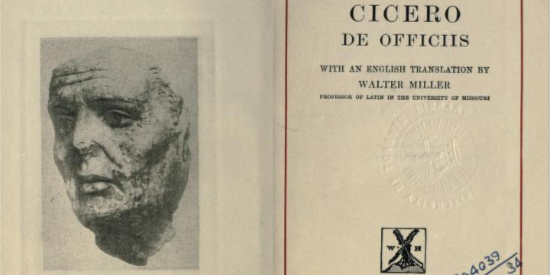
Anyway, intrigued by the aforementioned statement, I sought the original source, De Officiis (sometimes rendered ‘On Duties’ in English from Latin), in order to gain a firmer grasp of what Cicero was saying. I took myself to Cork City Library, where a friendly librarian carefully retrieved a few delicate copies of Cicero’s works from storage. Incidentally, with the world dripping in half-assed ‘AI’ slop, there is something reassuring about leafing through century-old books containing translations of elegantly composed literature that first sprung forth into the world from the mind of a Roman statesman over 2,000 years ago.
De Officiis was composed during the bitter fall of the Roman Republic and it was Cicero’s last major philosophical work before his assassination in 43 BC. In it, the embattled orator addresses his son Marcus and lays out a vision of how to live an honourable life in accordance with nature, using the principles of Stoicism as an anchor. The paragraph containing the line quoted by Hunham in The Holdovers is worth sharing in full as it expands on the idea of helping others and being open to receiving help, but it also discusses the importance of creatively working in harmony to strengthen social cohesion.
“As has been strikingly said by Plato, we are not born for ourselves alone, and our country claims her share, and our friends their share of us; and, as the Stoics hold, all that the earth produces is created for the use of man, so men are created for the sake of men, that they may mutually do good to one another; in this we ought to take nature for our guide, to throw into the public stock the offices of general utility by a reciprocation of duties; sometimes by receiving, sometimes by giving, and sometimes to cement human society by arts, by industry, and by our resources.”
– Cicero, De Officiis (1:22)1
*(my emphasis in bold)
There is nothing convoluted about the message, but it seems somehow alien when you survey the world as we know it now – a place where the President of the United States and his acolytes make a virtue out of wanton cruelty, emboldening the worst among us, while bafflingly influential figures such as the Tesla guy decry empathy as a weakness.
Hume knew well that even the best of us need reminders and that is especially true in an era when old certainties are rapidly dissolving before our very eyes. So, don’t invest much into the moronic ramblings of cruel demagogues and the craven whims of billionaire dorks. Instead, regularly remind yourself about worthy concepts, like non nobis solum nati sumus, and try to give life to them. Tell someone else about them. Say it over and over until they get it. Non nobis solum nati sumus. We are not born for ourselves alone.
- Translations vary. You can see another translation by Walter Miller at The Internet Archive. ↩︎
 Nothing is written